

































If you run a construction business, you’ll recognise this pattern: The work is done. The team has moved on. Everyone assumes the job is complete. But the cash has not arrived.
Somewhere between finishing the job and sending the invoice, things slow down. Information gets held up. Details need checking. Someone needs to confirm something. Before you know it, days or even weeks have passed.
This gap is easy to overlook because it rarely feels like a single problem. But across projects, it quietly builds into something much bigger. Cashflow pressure.
This is more widespread than many realise. Across the UK, late payments alone cost the economy billions each year and affect a significant proportion of businesses. In construction, long payment cycles of 60 to 90 days have become routine, putting strain right through the supply chain.
These delays are not just about clients paying late. They often start much earlier, inside your own processes.
The gap no one plans for
Most businesses invest time and energy in two things: Winning work and delivering it well. What often gets less attention is what happens next.
In many construction businesses, the journey from quote to invoice looks something like this:
- A quote is created in one system or document
- The job is delivered on site, with details captured separately
- Information is passed back to the office, often manually
- Admin teams assemble everything before raising the invoice
Each step depends on information being handed over, checked and sometimes re-entered. Every handover introduces friction.
If anything is missing or unclear, everything pauses. The invoice waits. And so does the payment.
Research shows that administrative errors, disputes and technical issues are among the most common reasons for delayed payments, rather than deliberate behaviour. In other words, the problem is often not unwillingness to pay. It is a breakdown in process.
When systems don’t connect, cashflow doesn’t either
For many established businesses, systems have evolved over time rather than being designed.
A quoting tool here. A spreadsheet there. A scheduling system. A finance platform. Each serving its purpose but not always working together.
The experience of Arthur C Towner reflects this familiar situation. Like many long-standing businesses, they had built up a mix of processes and systems, some digital, some manual, and some reliant on internal knowledge.
Individually, each part functioned. But collectively, they created friction.
Information did not always flow cleanly between teams. Planning, operations, and finance were not fully aligned. Tasks that should have been straightforward required additional coordination.
This kind of fragmentation does more than slow things down. It makes it harder to see what is happening across the business. And if you cannot clearly see when a job is complete, you cannot confidently invoice it.
The visibility problem
One of the biggest hidden blockers to faster payment is visibility.
On site, the work might be finished. But in the office, that completion is not always obvious. Details may still be sitting in notebooks, emails or waiting to be passed on.
That uncertainty leads to hesitation. Before invoicing, someone needs to check. Confirm. Clarify. Each of those steps adds time.
The construction sector is particularly vulnerable to this because of its layered structure. With multiple subcontractors, approvals and stages, information often moves slowly through the chain. This is where a more connected approach makes a tangible difference.
In the work Switchplane delivered for LandCruise Motorhome Hire, the business challenge was not construction, but the principle is the same. Workshop teams and office staff were not always working from the same real-time information.
By introducing a system where updates were captured and shared instantly, everyone could see the current status without chasing.
The result was simple but powerful. Less uncertainty. Fewer delays. Faster decisions.
Apply that to a construction business, and the impact is clear. When job status is visible in real time, the question of “are we ready to invoice?” becomes much easier to answer.
Small delays, big impact
Individually, these delays can feel minor. Waiting for a job sheet. Clarifying a variation. Re-entering data into another system.
But when they happen across dozens or hundreds of jobs, they add up quickly. The result is a steady drag on cashflow.
Across the sector, this is already a recognised challenge. Even where payment terms are agreed, many construction firms still experience variable or delayed payment timelines, creating ongoing financial pressure.
And because construction operates on tight margins and complex supply chains, delays do not just affect one business. They ripple through the entire network. This is why the industry continues to face high levels of insolvency linked to cashflow issues.
What changes when everything is connected
The alternative is not about chasing harder or tightening payment terms.
It is about removing the gaps altogether.
When quoting, delivery and invoicing are connected, the flow of information becomes much more natural. Instead of moving data between disconnected tools, everything works together. That means:
- Job details created at the quoting stage carry through to delivery
- Site updates are recorded once and shared instantly
- Completion is visible without needing to ask
- Finance teams have everything they need to invoice straight away
Returning to Arthur C Towner, the move to a more connected platform brought together planning, operations, and finance into a single, coherent system.
This reduced reliance on manual coordination and created a shared understanding across the business. In practical terms, it meant fewer delays between finishing the work and billing for it.
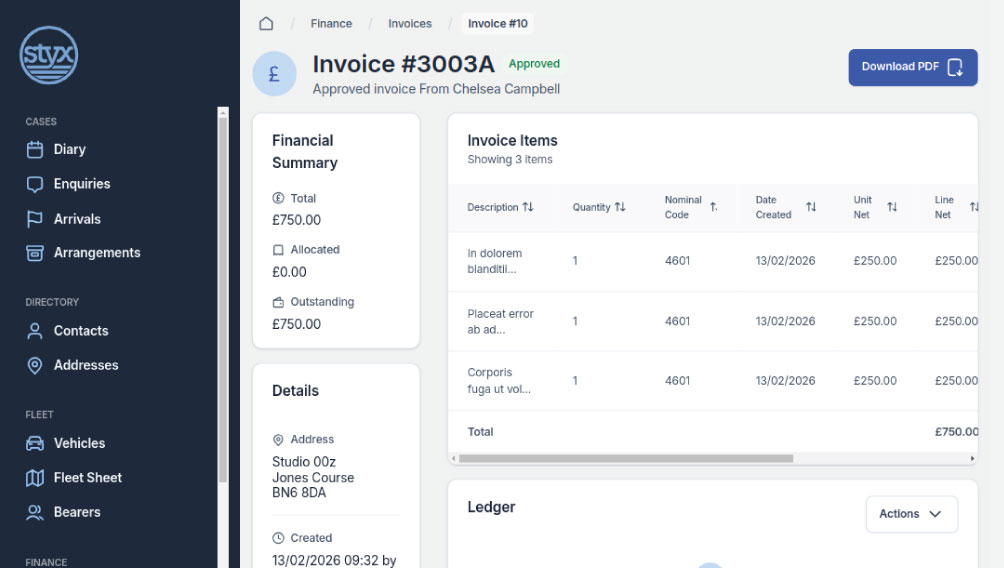
From job completion to invoice, without the pause
When a job is complete, everything required to invoice it should already be in place.
That means:
- The original scope is clearly defined
- Any changes are captured as they happen
- Completion is recorded in real time
- All relevant information is available to finance
When these conditions are met, invoicing becomes a natural next step, not a separate process that needs chasing. And that has a direct impact on cashflow.
Invoices go out sooner. Payment cycles start earlier. Revenue reflects the actual pace of work.
A better way to think about cashflow
Cashflow is often treated as a financial issue. But in many cases, it is an operational one.
Delays are not just caused by late-paying clients. They are created by the gaps between systems, teams, and processes. Closing those gaps changes the dynamic completely.
It reduces admin. Improves visibility. Keeps work moving forward. And crucially, brings the timing of payments closer to the reality of delivery.
For construction and built environment businesses, that can make a meaningful difference. Not just to finances, but to how the whole business feels to run.
Closing the gap
If there is one idea to take away, it is this.
Getting paid faster is not just about what happens after the invoice is sent. It starts much earlier. By connecting the steps between quoting, delivery and invoicing, you remove the friction that slows everything down. And when the process flows properly, so does the cash.
Switchplane works with organisations across construction and the built environment to design software that connects quoting, delivery, and invoicing, ensuring the right information is captured at the right moment and shared across the business.
By reducing gaps between teams and processes, this approach helps turn completed work into invoiced revenue more quickly and with greater confidence. If you would like to explore how more connected systems could support stronger cashflow and smoother operations in your business, we would be glad to start that conversation.
Get in touch
If you are looking to fix the gaps between job completion and invoicing and to get paid faster, contact us today for a chat.

References:
- Gov.uk: Late payment consultation: Time to pay up
- UK Parliament: Small business strategy
- Gov.uk: Late payments research: performance and practices across business
- Federation of Master Builders: Construction SMEs face mounting cost pressures and insolvencies despite continuous growth, report warns
- Stephensons: Breaking the cycle of late payment in the construction sector: 7 steps to improve your cashflow
- Switchplane Case Study: Meet Oliver at Arthur C Towner
- Switchplane Case Study: Meet Andy at Landcruise Motorhome Hire