
































Mark Elwell founded Summit Environmental in 2018, building a team that now delivers asbestos, fire, legionella, WRAC, and marine hazardous material surveys to clients across Sussex, London, and Kent. Their clients range from single residential flats to schools, councils, and MOD vessels, and the business has grown steadily every year since.
Behind the scenes, that growth was starting to outpace the tools running it. Summit relied on AlphaTracker for enquiries, quotes, and invoicing, and a separate app called Flow for surveys on site. The two didn't talk to each other, and neither was built around how Summit's team, led day to day by Office Manager Maddy Bishop, actually worked.
We helped Mark and Maddy by building Atlas, a single platform that follows a job from first enquiry through to invoice.
What could we do for you?
Before Switchplane
Mark was like you.
Summit had already outgrown one system before. AlphaTracker handled client records, quotes, and invoicing, but it was slow, especially with more than one person on it at once, and the browser-based interface wouldn't allow two tabs open at the same time. Raising an invoice could take the best part of a day.
Information didn't carry forward either. Everything entered against a quote stayed with the quote, so the team found themselves re-entering the same details once a job became a live project, then checking multiple folders on site to piece the full picture back together.
Client structure was another sticking point. Block management companies often sat behind several individual buildings, each with its own managing agent, but AlphaTracker had no way to link them. For reporting, four buildings under the same freeholder looked like four unrelated clients.
Surveys themselves worked well, captured through Flow's mobile app, but Flow and AlphaTracker were never connected, so survey data and office data lived in two separate worlds.
The system worked, but only because the team built workarounds around it.
The challenge
Mark wanted one system to replace two, without losing what already worked.
Summit didn't want to build a CRM and a survey tool from nothing. Flow did its job well. The priority was replacing AlphaTracker, the part of the business causing the most friction, with something built specifically around Summit's own process.
The new system needed to:
- Track a job from enquiry through to quote, survey, and invoice in one place
- Reflect the real structure of Summit's clients, including block managers and umbrella companies
- Keep quotes and their detail consistent, however they were written and by whom
- Speed up invoicing, one of the slowest and most frustrating parts of the old process
- Support the compliance expectations increasingly attached to council and public sector tenders
Getting the underlying structure right, how sites, buildings, clients, and quotes relate to one another, mattered more than getting quotes out quickly at the start. Everything else depended on it.
Working with us
We built what Mark and Maddy needed.
We began with a discovery phase to properly understand how Summit's clients, sites, buildings, quotes, and jobs all connect to one another, particularly for block management clients with several buildings under one umbrella. Getting that structure right early meant everything built afterwards could rely on it, rather than working around it.
From there, we worked in two-week sprints, building a skeleton first (add a client, raise an invoice) and expanding it in the direction Summit's own workflow already ran: enquiry, quote, survey, invoice.
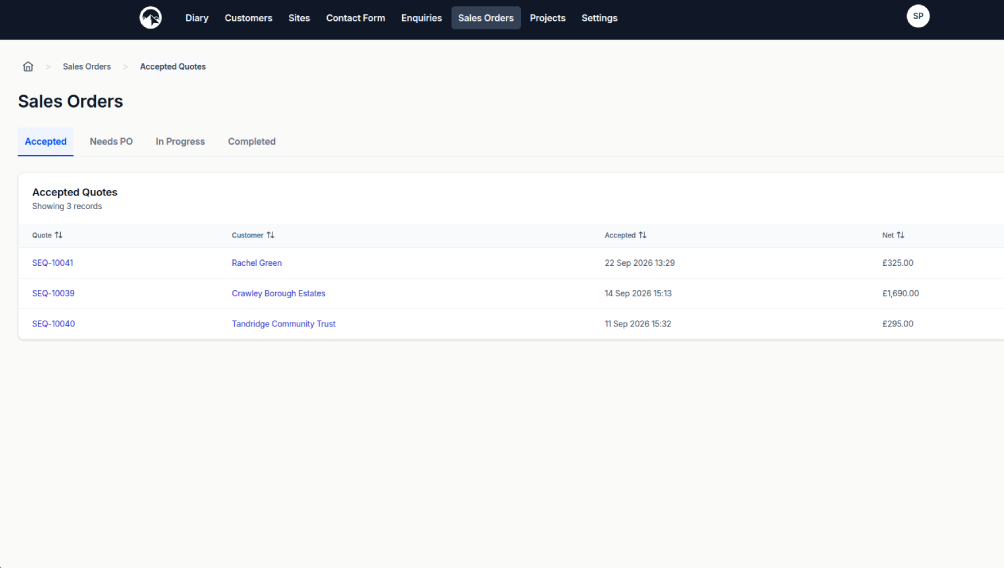
From first enquiry to won
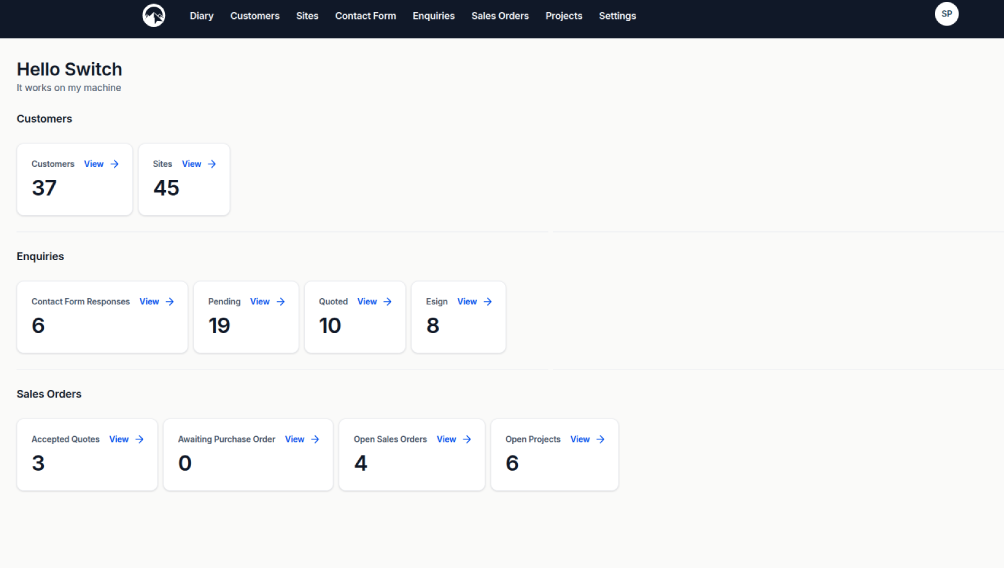
Nothing gets lost between the phone call and the quote
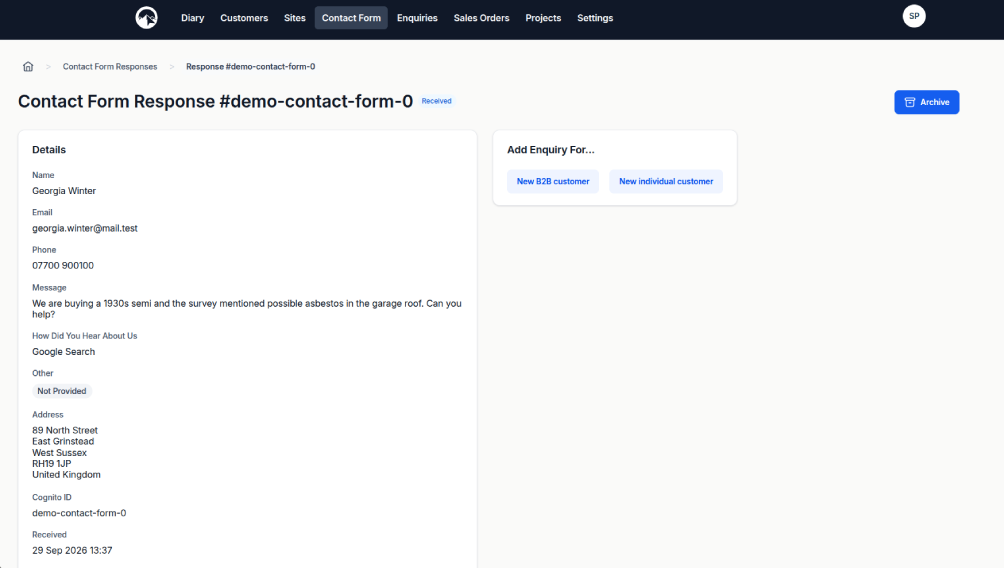
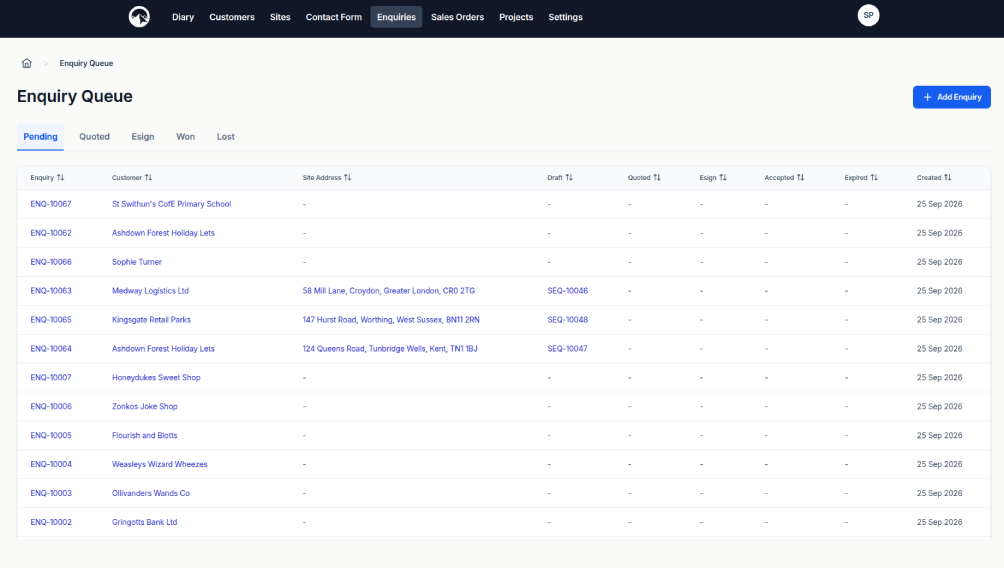
Every enquiry, whether it comes by phone or through the website, is logged against the right customer from the start, with a record of who took it and when. Existing customers are matched automatically, and new ones can be set up on the spot without losing the thread of the conversation.
Enquiries move through clear stages, open, won, or lost, so nothing sits unclear or forgotten while the team decides what happens next.
Quotes that read the same, whoever writes them
Consistency, without extra typing
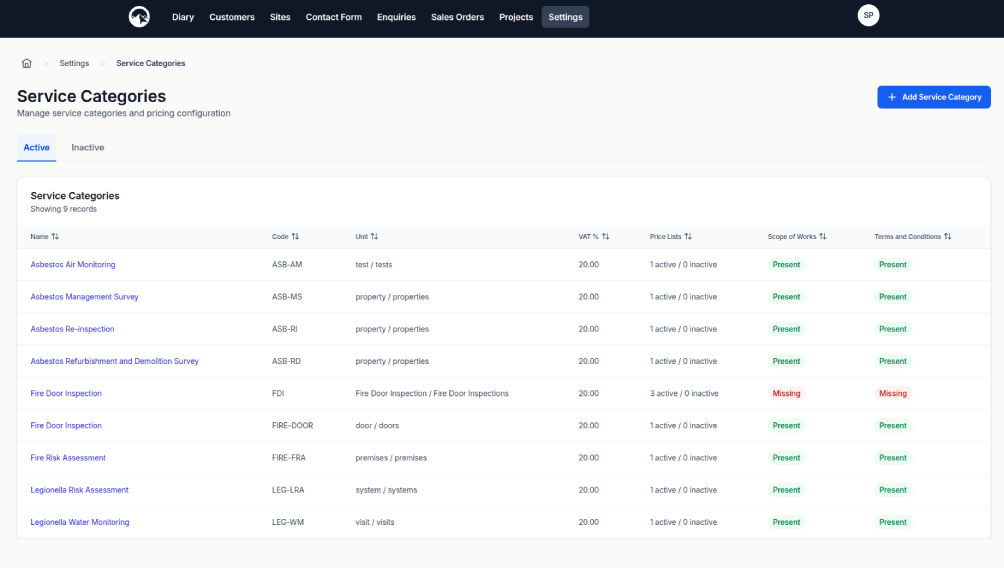
Each service Summit offers, asbestos, fire, legionella, and the rest, has its own standard description, scope of works, and terms built in. When a consultant puts a quote together, that detail is pulled in automatically, rather than typed out fresh each time.
Quotes can cover one service or several, across a single site or several sites, and everything stays together in one place rather than scattered across separate calculation spreadsheets. If the wording or pricing for a service ever changes, every quote using it updates too, so nothing is left out of date.
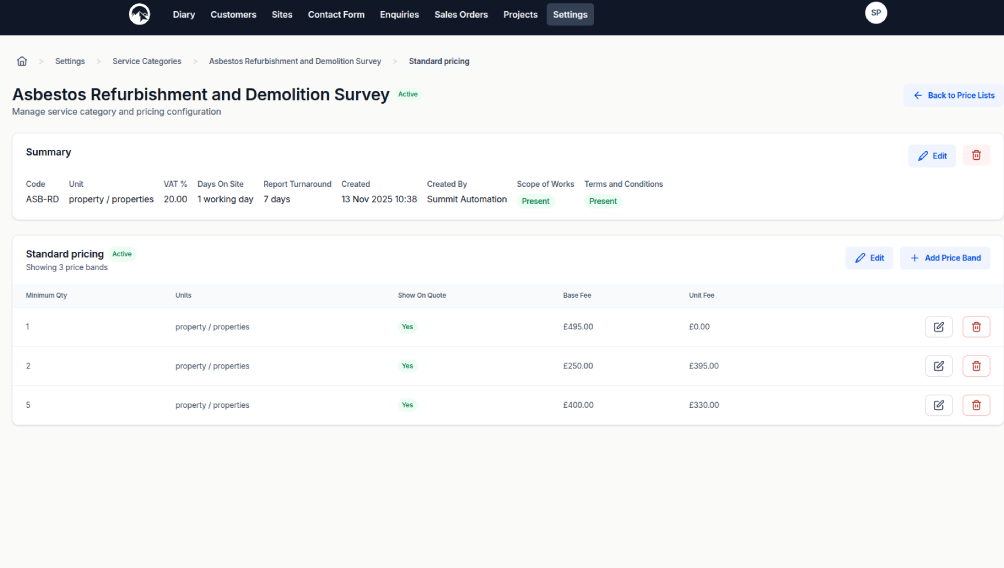
Approval, however the client prefers it
Esign, email, or purchase order, all recorded the same way
Clients can approve a quote by esigning it, by email, or by purchase order, and every quote now carries the correct scope of works and terms and conditions before it can be approved at all. Public sector and block management clients that require a purchase order reference are flagged automatically, so nothing moves forward without the paperwork behind it.
Every approval, whoever gave it and however it arrived, is recorded against the quote with a full audit trail.
One record, from quote to site to invoice
No more re-entering the same information twice
Once a quote is won, it becomes a live job automatically, carrying its pricing and detail with it. The information the team entered while quoting is the same information that reaches site and, eventually, the invoice.
Each job tracks its own progress, from RAMS through to results, drawings, and the final report, so the team can see exactly what stage a job is at without digging through folders or asking around. Once everything is signed off, billing follows on from the same record.
A diary built around the job, not just the date
Scheduling that reflects who's on site, and where
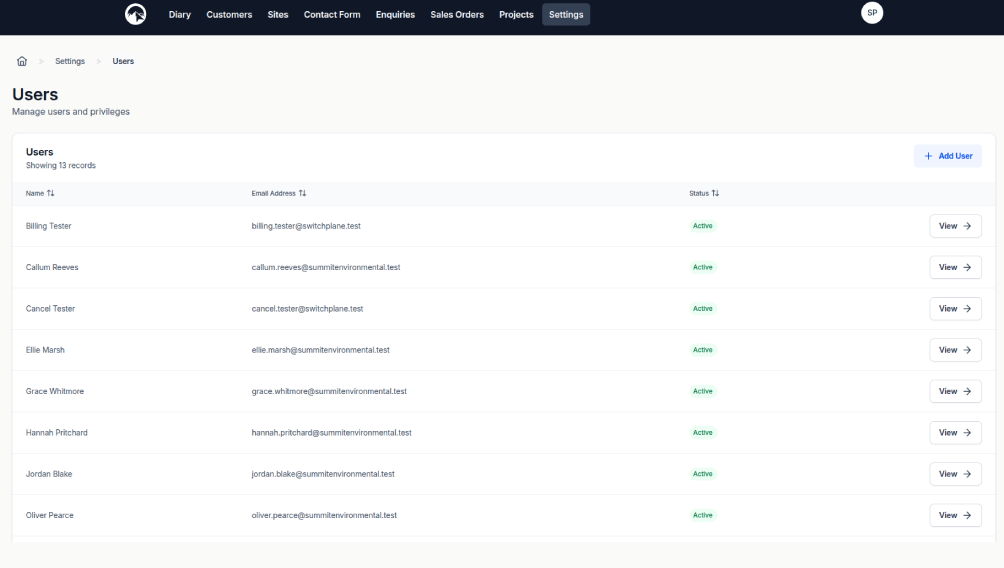
Diary entries label themselves from the job and the service involved, so a scheduler can see at a glance what a booking is for without opening it up. They can also check availability across the whole team at once, by person, by site, or by service, rather than looking up one surveyor at a time.
The outcome
One system, from enquiry to invoice, going live imminently
Atlas is close to replacing AlphaTracker entirely, and the shift is already changing how Summit works. Quotes read consistently, whoever writes them. Block management clients with several buildings under one roof are now properly linked together, rather than looking like unrelated customers. Purchase order requirements are caught automatically rather than chased after the fact.
Most importantly, information no longer has to be re-entered as a job moves from enquiry to quote to project to invoice. It carries forward on its own, which is exactly where the old system fell down.
"The platform itself has proven to be intuitive, reliable, and highly effective. We are delighted with the results so far and would not hesitate to recommend your company to any other organisations seeking a dependable and innovative software partner. We look forward to continuing our successful partnership for many years to come."
- Mark Elwell, Director, Summit Environmental
The techy bit...
Atlas runs on AWS, a Switchplane PHP container on ECS, with MySQL on RDS, the same pattern behind our other platforms. Files, reports, photos, attachments, are stored in a private S3 bucket, isolated to Summit and inaccessible from outside the platform. Nothing is ever truly deleted; records are flagged and archived instead, so anything removed by mistake can still be recovered. Every change of significance, an approval, a status update, a re-coded quote line, is written to a business event history, giving Summit a full audit trail without anyone having to build one manually. Error monitoring runs continuously, and updates ship in two-week sprints without taking the system offline. Sign-in currently uses email and password, with Microsoft sign-in now available for those who prefer it, ahead of a move to full single sign-on as the team grows.
Now, how can we help you?
Are you like Mark?
If your team is running enquiries, quotes, and jobs across systems that don't talk to each other, chasing information that should already be there, it may be time to bring it all together.
We help growing consultancies and service businesses replace fragmented software with a single platform that reflects how they actually work, not how an off-the-shelf tool assumes they should.
hey!
We help organisations be the best they can be. If you're ready for software and AI to drive your transformational growth, why not get in touch today?